*상관계수
*피어슨 상관계수
연속형 변수(등간척도, 비율척도)로 측정된 변수들 사이의 선형관계를 나타냄
from scipy.stats import pearsonr

stats.pearsonr(x=data['GRE'], y=data['LOR'])
#data[['GRE', 'TOEFL', 'LOR']].corr(method='pearson')  # (-1 ~ 1)
q45['pair'] = q45.apply(lambda x: tuple(sorted([x['v1'], x['v2']])), axis=1) # 순서를 무시하고 정렬하여 튜플로 생성
q45 = q45.drop_duplicates('pair').drop(columns='pair') # 'pair' 값 중복 행 제거하고, pair 컬럼 삭제import pandas as pd
import pingouin as pg
df = pd.DataFrame({
'x': [1, 2, 3, 4, 5],
'y': [2, 4, 5, 4, 5]
})
pg.corr(x=df['x'], y=df['y'], method='pearson')
*BF10: 귀무가설 vs 대립가설 중 어느 쪽이 더 타당한지를 비교하는 베이지안 통계의 핵심 지표

*스피어만 순위상관계수
관측치가 서열척도로 되어 있을 때
from scipy.stats import spearmanr

stats.spearmanr(X, Y)
*켄달의 타우
관측치가 서열척도로 되어 있을 때, 수치형 관측치의 분포가 극단적인 분포를 보일 때
from scipy.stats import kendalltau

corr, p = kendalltau(X, Y)
※ 단조 관계: 하나의 변수의 값이 증가하거나 감소함에 따라 다른 변수도 일관되게 증가/감소하는 패턴을 보이는 관계
→ X, Y 변수 간 차이가 있으면 켄달의 타우를 사용하자!

→ p < 0.05, 통계적으로 유의하므로, 관계 없음
*크라메르의 연관계수 (p.224)
두 범주형 변수 간의 연관성을 측정
카이제곱 독립성 검정을 확장한 것으로, 두 범주형 변수가 서로 얼마나 연관되어 있는지를 0에서 1까지의 값으로 나타냅
import numpy as np
import pandas as pd
from scipy.stats import chi2_contingency
import math

data = np.array([[50, 30, 20], [30, 40, 30], [20, 10, 50]])

# 교차표에 대한 카이제곱 독립성 검정 수행
chi2, p, dof, expected = chi2_contingency(data)

# 총 관측값
n = np.sum(data)

# 크라메르의 V 계산
k = min(data.shape)  # 행과 열 중 작은 값
cramers_v = math.sqrt(chi2 / (n * (k - 1)))

print(f"카이제곱 통계량: {chi2}")
print(f"p-값: {p}")
print(f"크라메르의 연관계수: {cramers_v:.4f}")
import numpy as np
from scipy.stats.contingency import association
data = np.array([[50, 30, 20], [30, 40, 30], [20, 10, 50]])
cramers_v = association(data, method='cramer')
print(f"크라메르의 연관계수: {cramers_v:.4f}")→ 0.6 이상인 경우, 연관성이 높다고 봄
*편 상관관계 분석
import pandas as pd
import pingouin as pg

data = {
    'X': [10, 20, 30, 40, 50, 60],
    'Y': [9, 19, 29, 41, 49, 59],
    'Z': [1, 2, 3, 4, 5, 6]
}

df = pd.DataFrame(data)

partial_corr = pg.partial_corr(data=df, x='X', y='Y', covar='Z')  # covar=['Z', 'W']
print(partial_corr)
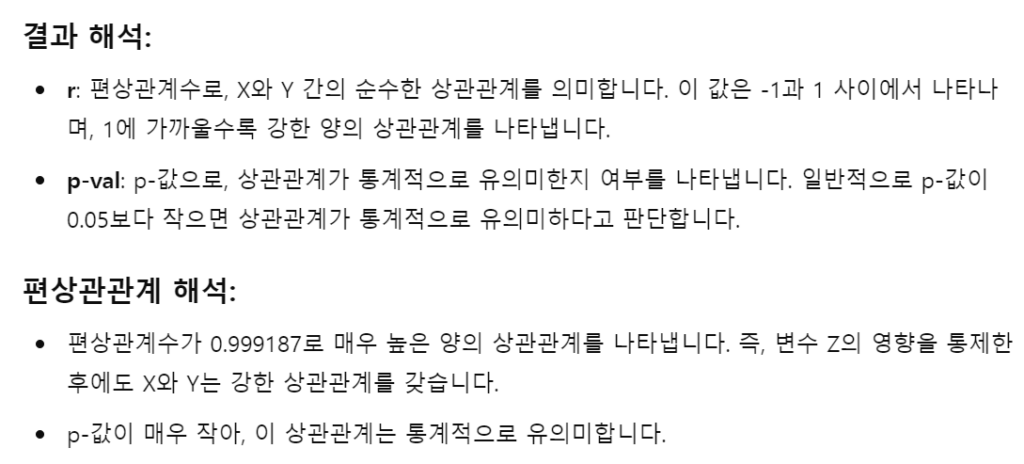
*선형 회귀분석
① 회귀 모형이 통계적으로 유의한가? – F 통계량
→ p-value가 유의수준(a) 보다 작으면 통계적으로 유의함
② 모형은 데이터를 얼마나 설명할 수 있는가? – R2
③ 회귀계수는 유의한가? – t 값
import statsmodels.api as sm
import pandas as pd

data = {
    'X1': [1, 2, 3, 4, 5],
    'X2': [2, 3, 4, 5, 6],
    'y': [1, 2, 1.3, 3.75, 2.25]
}
df = pd.DataFrame(data)

X = df[['X1', 'X2']]
y = df['y']

X = sm.add_constant(X)  # 상수 항 추가 (절편을 포함하기 위해)

model = sm.OLS(y, X).fit()
print(model.summary())

new_data = pd.DataFrame({
    'const': 1,  # 상수 항 추가
    'X1': [6, 7],
    'X2': [7, 8]
})
predictions = model.predict(new_data)
print(predictions)
*교호작용이 있는 회귀모형
# 교호작용 항 추가
df['X1_X2'] = df['X1'] * df['X2']  # X1과 X2의 상호작용 항

# 독립 변수 (교호작용 항 포함, 상수항 추가)
X_interaction = sm.add_constant(df[['X1', 'X2', 'X1_X2']])

model_interaction = sm.OLS(df['y'], X_interaction).fit()
print(model_interaction.summary())
import pandas as pd
from statsmodels.formula.api import ols
import matplotlib.pyplot as plt
house = pd.read_csv('data/kc_house_data_gpt.csv')
house = house[['price', 'sqft_living']]
house.corr() # 상관관계 확인
y = house['price']
x = house[['sqft_living']]
lr = ols('price ~ sqft_living', data=house).fit()
pred = lr.predict(x)
print(lr.summary())
plt.scatter(x['sqft_living'], y)
plt.plot(x['sqft_living'], pred, color='red')
plt.show()
test_data = pd.DataFrame({
'sqft_living': [1200, 1500, 2000, 2500, 3000]
})
test_pred = lr.predict(test_data)
print("Test Predictions:")
print(test_pred)
plt.scatter(test_data['sqft_living'], test_pred, color='blue', marker='x', label='Test Predictions')
plt.plot(x['sqft_living'], pred, color='red', label='Training Data Fit')
plt.xlabel('Square Feet of Living Space')
plt.ylabel('Price')
plt.legend()
plt.show()
- 회귀 모델 통계적으로 유의함
- 설명력 97.6%로 성능 우수
- 회귀계수도 유의하므로, Price = sqft_living*279.7792 + 4069.0715 회귀식 도출


*영향치 판단(Cook’s distance 등)
import pandas as pd
import numpy as np
import statsmodels.api as sm
from statsmodels.stats.outliers_influence import OLSInfluence
import matplotlib.pyplot as plt

data = {
    'Area': [150, 200, 250, 300, 350, 400, 450, 500, 550, 600],
    'Bedrooms': [2, 3, 3, 4, 4, 4, 5, 5, 5, 6],
    'Distance': [5, 4, 4, 3, 3, 2, 2, 1, 1, 1],
    'Price': [300, 400, 350, 500, 550, 600, 700, 650, 700, 800]
}
df = pd.DataFrame(data)

X = df[['Area', 'Bedrooms', 'Distance']]
y = df['Price']

X = sm.add_constant(X)
model = sm.OLS(y, X).fit()

influence = OLSInfluence(model)
cooks_d = influence.cooks_distance[0]

print(cooks_d)

import pandas as pd
import numpy as np
import statsmodels.api as sm
import statsmodels.formula.api as smf

X = sm.add_constant(df['x'])
model = sm.OLS(df['y'], X).fit()

influence = model.get_influence()
cooks_d, _ = influence.cooks_distance
dfbetas = influence.dfbetas
dffits = influence.dffits[0]
leverage = influence.hat_matrix_diag
#시각화: sm.graphics.influence_plot()
*다중 선형 회귀
*다중공선성
- 상관성 0.9 이상
- VIF(Variance Inflation Factor) 값이 10 이상이면 다중공선성 존재
import pandas as pd
import numpy as np

import statsmodels.api as sm
import statsmodels.formula.api as smf

from patsy import dmatrices
from statsmodels.stats.outliers_influence import variance_inflation_factor

Cars = pd.read_csv('data/Cars93.csv')
Cars.columns = Cars.columns.str.replace('.', '')

model = smf.ols(formula='Price ~ EngineSize + RPM + Weight + Length + MPGcity + MPGhighway', data=Cars)

result = model.fit()
print(result.summary())
print(Cars[['EngineSize', 'RPM', 'Weight', 'Length', 'MPGcity', 'MPGhighway']].corr())

# 독립변수와 종속변수를 데이터프레임으로 나누어 저장
y, X = dmatrices('Price ~ EngineSize + RPM + Weight + Length + MPGcity + MPGhighway', data=Cars, return_type='dataframe')

vif_list = []
for i in range(1, len(X.columns)):
    vif_list.append([variance_inflation_factor(X.values, i), X.columns[i]])
print(pd.DataFrame(vif_list, columns=['vif', 'variable']))

→ MPGcity, MPGhighway는 0.9 이상의 상관성을 보이므로 다중공선성이 존재함을 알 수 있음
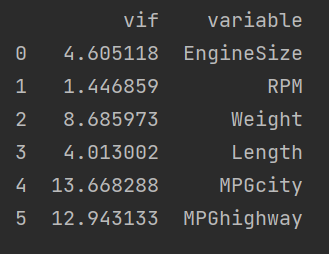
→ VIF 값을 통해 다중공선성을 확인한 결과 MPGcity 변수를 제거해야 함을 알 수 있음
*MPGcity 변수를 제거하고 다시 돌려보자
model = smf.ols(formula='Price ~ EngineSize + RPM + Weight + Length + MPGhighway', data=Cars)
result = model.fit()
print(result.summary())
→ MPGhighway p-value가 현저히 낮아진 것을 볼 수 있음
*변수선택법 – 전진선택법/후진제거법/단계선택법 (p.241)
import time
import itertools
import pandas as pd

import statsmodels.api as sm
import statsmodels.formula.api as smf
from statsmodels.formula.api import ols
from statsmodels.stats.anova import anova_lm
from patsy import dmatrices

data = pd.read_csv('data/Cars93.csv')
y, X = dmatrices('Price ~ EngineSize + RPM + Weight + Length + MPGcity + MPGhighway', data=data, return_type="dataframe")

def processSubset(X, y, feature_set):
    model = sm.OLS(y, X[list(feature_set)])
    regr = model.fit()
    AIC = regr.aic
    return {"model": regr, "AIC": AIC}

def forward(X, y, predictors):
    tic = time.time()
    remaining_predictors = [p for p in X.columns.difference(['Intercept']) if p not in predictors]

    results = []
    for p in remaining_predictors:
        results.append(processSubset(X=X, y=y, feature_set=predictors+[p]+['Intercept']))
    models = pd.DataFrame(results)
    best_model = models.loc[models['AIC'].argmin()]
    toc = time.time()

    print("Processed", models.shape[0], "models on", len(predictors)+1, "predictors in", (toc-tic))
    print("Selected predictors:", best_model['model'].model.exog_names, "AIC:", best_model[0])
    return best_model

def backward(X, y, predictors):
    tic = time.time()

    results = []
    for combo in itertools.combinations(predictors, len(predictors) -1):
        results.append(processSubset(X=X, y=y, feature_set=list(combo)+['Intercept']))
    models = pd.DataFrame(results)
    best_model = models.loc[models['AIC'].argmin()]
    toc = time.time()

    print("Processed", models.shape[0], "models on", len(predictors)+1, "predictors in", (toc-tic))
    print("Selected predictors:", best_model['model'].model.exog_names, "AIC:", best_model[0])
    return best_model

### 단계선택법
def stepwise_model(X,y):
    stepModels = pd.DataFrame(columns=["AIC","model"])
    tic = time.time()

    predictors = []
    SmodelBefore = processSubset(X, y, predictors + ['Intercept'])['AIC']

    predictors = []
    for i in range(1, len(X.columns.difference(['Intercept']))+1):
        forwardResult = forward(X,y,predictors)
        print("forward")
        stepModels.loc[i] = forwardResult
        predictors = stepModels.loc[i]["model"].model.exog_names
        predictors = [k for k in predictors if k != 'Intercept']
        backwordResult = backward(X,y,predictors)
        if backwordResult['AIC'] < forwardResult['AIC']:
            stepModels.loc[i] = backwordResult
            predictors=stepModels.loc[i]["model"].model.exog_names
            smodelBefore=stepModels.loc[i]["AIC"]
            predictors=[k for k in predictors if k != 'Intercept']
            print('backward')
        if stepModels.loc[i]["AIC"] > SmodelBefore:
            break
        else:
            smodelBefore = stepModels.loc[i]["AIC"]
    toc = time.time()

    print("Total elapsed time : ", (toc - tic), "seconds")
    return (stepModels['model'][len(stepModels['model'])])

Stepwise_best_model = stepwise_model(X=X, y=y)
print(Stepwise_best_model.summary())

### 전진선택법
def forward_model(X, y):
    fModels = pd.DataFrame(columns=["AIC", "model"])
    tic = time.time()

    predictors = []
    for i in range(1, len(X.columns.difference(['Intercept'])) + 1):
        forwardResult = forward(X, y, predictors)
        if i > 1:
            if forwardResult['AIC'] > fmodelBefore:
                break
        fModels.loc[i] = forwardResult
        predictors = fModels.loc[i]["model"].model.exog_names
        fmodelBefore = fModels.loc[i]["AIC"]
        predictors = [k for k in predictors if k != 'Intercept']
    toc = time.time()
    print("Total elapesed time : ", (toc - tic), "seconds.")
    return (fModels['model'][len(fModels['model'])])

#Forward_best_model = forward_model(X=X, y=y)
#print(Forward_best_model.summary())

### 후진제거법(후진소거법)
def backward_model(X, y):
    BModels = pd.DataFrame(columns=["AIC", "model"])
    tic = time.time()

    predictors = X.columns.difference(['Intercept'])
    BmodelBefore = processSubset(X, y, predictors)['AIC']

    while (len(predictors) > 1):
        backwardResult = backward(X, y, predictors)
        if backwardResult['AIC'] > BmodelBefore:
            break
        BModels.loc[len(predictors) - 1] = backwardResult
        predictors = BModels.loc[len(predictors) - 1]["model"].model.exog_names
        BmodelBefore = backwardResult["AIC"]
        predictors = [k for k in predictors if k != 'Intercept']
    toc = time.time()
    print("Total elapsed time :", (toc - tic), "seconds.")
    return (BModels["model"].dropna().iloc[0])

#Backward_best_model = backward_model(X=X, y=y)
#print(Backward_best_model.summary())
→ 최종적으로 Weight, RPM, EngineSize가 포함된 다중 선형 회귀 모델을 채택, but 설명력이 낮음(54.7%)
y = 0.0073*Weight + 0.0071*RPM + 4. 3054*EngineSize – 51.7933
*GPT가 만들어준 더 짧은 코드
import pandas as pd
import statsmodels.api as sm
from patsy import dmatrices

data = pd.read_csv('data/Cars93.csv')
y, X = dmatrices('Price ~ EngineSize + RPM + Weight + Length + MPGcity + MPGhighway', data=data, return_type="dataframe")

X = sm.add_constant(X)

def forward_selection(X, y):
    initial_features = []
    best_features = []

    while len(initial_features) < len(X.columns):
        remaining_features = [f for f in X.columns if f not in initial_features]
        pvals = pd.Series(index=remaining_features)
        for feature in remaining_features:
            model = sm.OLS(y, X[initial_features + [feature]]).fit()
            pvals[feature] = model.pvalues[feature]
        min_pval = pvals.min()
        if min_pval < 0.05:
            best_feature = pvals.idxmin()
            initial_features.append(best_feature)
            best_features.append(best_feature)
        else:
            break

    return best_features

selected_features = forward_selection(X, y)
print("Selected features:", selected_features)
Forward_best_model = sm.OLS(y, sm.add_constant(X[selected_features])).fit()
print(Forward_best_model.summary())
def backward_elimination(X, y):
features = X.columns.tolist()
while len(features) > 0:
model = sm.OLS(y, X[features]).fit()
pvals = model.pvalues[1:] # 상수(const)를 제외한 변수들의 p-value 확인
max_pval = pvals.max()
if max_pval > 0.05:
worst_feature = pvals.idxmax()
features.remove(worst_feature)
else:
break
return features
selected_features = backward_elimination(X, y)
print("Selected features:", selected_features)
Backward_best_model = sm.OLS(y, sm.add_constant(X[selected_features])).fit()
print(Backward_best_model.summary())def stepwise_selection(X, y, initial_list=[], threshold_in=0.05, threshold_out=0.05):
included = list(initial_list)
while True:
changed = False
# forward step
excluded = list(set(X.columns) - set(included))
new_pval = pd.Series(index=excluded)
for new_column in excluded:
model = sm.OLS(y, sm.add_constant(X[included + [new_column]])).fit()
new_pval[new_column] = model.pvalues[new_column]
best_pval = new_pval.min()
if best_pval < threshold_in:
best_feature = new_pval.idxmin()
included.append(best_feature)
changed = True
# backward step
model = sm.OLS(y, sm.add_constant(X[included])).fit()
pvalues = model.pvalues.iloc[1:] # 상수 제외
worst_pval = pvalues.max()
if worst_pval > threshold_out:
worst_feature = pvalues.idxmax()
included.remove(worst_feature)
changed = True
if not changed:
break
return included
selected_features = stepwise_selection(X, y)
print("Selected features:", selected_features)
Stepwise_best_model = sm.OLS(y, sm.add_constant(X[selected_features])).fit()
print(Stepwise_best_model.summary())*더더더 짧은 GPT 코드
from mlxtend.feature_selection import SequentialFeatureSelector as SFS
from sklearn.linear_model import LinearRegression
from sklearn.datasets import fetch_california_housing
from sklearn.model_selection import train_test_split
import pandas as pd

housing = fetch_california_housing()
X = pd.DataFrame(housing.data, columns=housing.feature_names)
y = pd.Series(housing.target, name="PRICE")

X_train, X_test, y_train, y_test = train_test_split(X, y, random_state=0)

model = LinearRegression()

sfs_forward = SFS(model, k_features='best', forward=True, floating=False, scoring='r2', cv=5)
sfs_forward.fit(X_train, y_train)
print('전진선택법 선택 변수:', sfs_forward.k_feature_names_)

# 후진제거법
sfs_backward = SFS(model, k_features='best', forward=False, floating=False, scoring='r2', cv=5)
sfs_backward.fit(X_train, y_train)
print('후진제거법 선택 변수:', sfs_backward.k_feature_names_)

# 단계선택법 (Stepwise)   # floating=True → Stepwise
sfs_stepwise = SFS(model, k_features='best', forward=True, floating=True, scoring='r2', cv=5)
sfs_stepwise.fit(X_train, y_train)
print('단계선택법 선택 변수:', sfs_stepwise.k_feature_names_)
*가장 낮은 AIC를 가지는 모델을 선택하고 저장
→ 모든 변수 조합을 평가하는 방법 (Exhaustive Search)
import pandas as pd
import statsmodels.api as sm
from patsy import dmatrices
import itertools
import time
pd.set_option('display.max_colwidth', None)

data = pd.read_csv('data/Cars93.csv')
y, X = dmatrices('Price ~ EngineSize + RPM + Weight + Length + MPGcity + MPGhighway', data=data, return_type="dataframe")

X = sm.add_constant(X)
X.rename(columns={'const': 'Intercept'}, inplace=True)

# 특정 변수 조합의 모델을 평가하는 함수
def processSubset(X, y, feature_set):
    model = sm.OLS(y, X[feature_set]).fit()
    AIC = model.aic
    return {"model": model, "AIC": AIC, "features": feature_set}

# 모든 조합에서 최적의 모델을 선택하는 함수
def getBestModel(X, y):
    best_AIC = float('inf')
    best_model = None
    best_features = None

    # 변수의 모든 가능한 조합을 시도
    for k in range(1, len(X.columns) + 1):
        for combo in itertools.combinations(X.columns, k):
            result = processSubset(X, y, list(combo))
            if result['AIC'] < best_AIC:
                best_AIC = result['AIC']
                best_model = result['model']
                best_features = result['features']

    return best_model, best_AIC, best_features

# 최적 모델 선택
best_model, best_AIC, best_features = getBestModel(X, y)

# 최적 모델 출력
print("\nSelected features:", best_features)
print("Best AIC:", best_AIC)
print("\nBest Model Summary:")
print(best_model.summary())
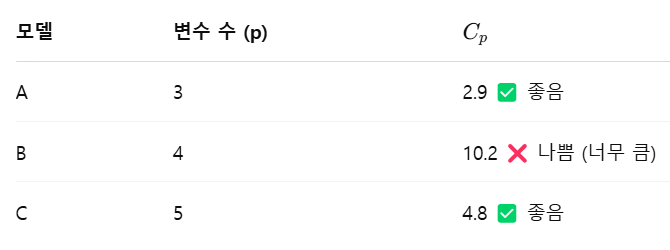
*Mallow’s Cp를 이용한 변수 선택
import numpy as np
import pandas as pd
from sklearn.linear_model import LinearRegression
from sklearn.metrics import mean_squared_error
from itertools import combinations
import statsmodels.api as sm

np.random.seed(42)
n = 100
X = np.random.randn(n, 5)  # 5개의 독립 변수
beta = np.array([2, -1, 0.5, 0, 0])  # 실제 계수
y = X @ beta + np.random.randn(n) * 0.5  # 종속 변수

df = pd.DataFrame(X, columns=['X1', 'X2', 'X3', 'X4', 'X5'])
df['y'] = y

# 2. 전체 모델에서 잔차 제곱합(RSS)과 분산 추정
full_X = sm.add_constant(df[['X1', 'X2', 'X3', 'X4', 'X5']])
full_model = sm.OLS(df['y'], full_X).fit()
sigma2 = full_model.mse_resid  # 잔차 분산 추정

# 3. Mallow's Cp 계산 함수
def mallows_cp(rss, p, sigma2, n):
    return rss / sigma2 - (n - 2 * p)

# 4. 변수 조합별 Mallow's Cp 계산
X_cols = ['X1', 'X2', 'X3', 'X4', 'X5']
n = df.shape[0]

results = []
for k in range(1, len(X_cols) + 1):
    for combo in combinations(X_cols, k):
        # 변수 조합으로 회귀 모델 적합
        X_train = df[list(combo)]
        model = LinearRegression().fit(X_train, df['y'])

        # 잔차 제곱합(RSS) 계산
        y_pred = model.predict(X_train)
        rss = mean_squared_error(df['y'], y_pred) * len(df['y'])

        # Cp 계산
        p = len(combo) + 1  # 상수항 포함한 변수 수
        cp = mallows_cp(rss, p, sigma2, n)
        results.append((combo, cp))

# 5. Cp 값에 따라 정렬하여 출력
results.sort(key=lambda x: x[1])
for combo, cp in results:
    print(f"Variables: {combo}, Cp: {cp:.2f}")

*등분산성 검사
import statsmodels.stats.api as sms

X = sm.add_constant(X)

model = sm.OLS(y, X).fit()
bp_test = sms.het_breuschpagan(model.resid, model.model.exog)

labels = ['Lagrange multiplier statistic', 'p-value', 'f-value', 'f p-value']
print(dict(zip(labels, bp_test)))
fitted = model.predict(data[['CGPA', 'GRE', 'LOR', 'Research', 'TOEFL']])
residual = data['Chance_of_Admit'] - fitted
sns.regplot(fitted, residual, lowess=True, line_kws={'color': 'red'})
plt.plot([fitted.min(), fitted.max()], [0,0], '--', color='grey')
*등분산성을 만족하지 않는 경우
→ 가중 최소제곱법(Weighted Least Squares, WLS) 혹은 Heteroscedasticity-Robust Standard Errors 계산
X = sm.add_constant(X)

ols_model = sm.OLS(y, X).fit()

# 잔차의 절대값을 새로운 종속변수로 사용하여 가중치를 추정
residuals_abs = abs(ols_model.resid)
wls_model = sm.OLS(residuals_abs, X).fit()
weights = 1 / wls_model.predict(X) ** 2

# 가중치를 적용한 WLS 모델 적합
wls_model = sm.WLS(y, X, weights=weights).fit()
print(wls_model.summary())
X = sm.add_constant(X)
ols_model = sm.OLS(y, X).fit()
robust_ols_model = ols_model.get_robustcov_results()
print(robust_ols_model.summary())*정규성 검사
sr = stats.zscore(residual)
(x,y), _ = stats.probplot(sr)
sns.scatterplot(x,y)
plt.plot([-3,3], [-3,3], '--', color='grey')stats.shapiro(redisual)→ p-value가 유의 수준보다 작으면 정규분포가 아니다
*Kolmogorov-Smirnov 검정 (두 분포의 동일성 검정) – 두 개의 표본 데이터가 같은 분포를 따르는지 검정
import numpy as np
from scipy import stats

# 두 개의 데이터 샘플 생성 (하나는 정규분포, 하나는 균등분포)
np.random.seed(0)
data1 = np.random.normal(0, 1, 100)
data2 = np.random.uniform(-1, 1, 100)

statistic, p_value = stats.ks_2samp(data1, data2)

print(f"KS 통계량: {statistic}")
print(f"p-value: {p_value}")
*Kolmogorov-Smirnov 검정 (분포 적합성 검정) – 표본이 정규 분포를 따르는지 확인

import numpy as np
from scipy import stats

# 정규 분포에서 샘플 생성
np.random.seed(0)
data = np.random.normal(0, 1, 100)

# KS 검정 (정규 분포와 비교)
statistic, p_value = stats.kstest(data, 'norm')

print(f"KS 통계량: {statistic}")
print(f"p-value: {p_value}")
*정규성을 만족하지 않는 경우
→ 이상치나 정규성 위반의 영향을 덜 받는 Robust Regression 수행
→ 종속 변수가 특정 분포(예: 이항, 포아송)를 따를 때, 정규성 가정이 필요 없는 일반화 선형 모델을 사용할 수도 있음
→ 로그 변환, Box-Cox 변환 등
import pandas as pd
import statsmodels.api as sm
import statsmodels.stats.api as sms
from patsy import dmatrices

data = pd.read_csv('data/Cars93.csv')
y, X = dmatrices('Price ~ EngineSize + RPM + Weight + Length + MPGcity + MPGhighway', data=data, return_type="dataframe")

X = sm.add_constant(X)

robust_model = sm.RLM(y, X).fit()

print(robust_model.summary())
*독립성 검정
→ summary() 결과 값에 나오는 Durbin-Watson 확인
→ 2에 가까울수록 자기 상관이 없고, 0에 가까우면 양의 상관 관계, 4에 가까우면 음의 상관 관계
from statsmodels.stats.stattools import durbin_watson
durbin_watson(model.resid)
*독립성 검정을 만족하지 않는 경우
→ 다중공선성을 확인하거나, 릿지, 라쏘, 주성분, 부분 최소 제곱 회귀 등의 방법을 사용
'데이터 분석 > ADP 자격증 공부' 카테고리의 다른 글
| (파이썬 한권으로 끝내기) 연관분석 (0) | 2026.04.06 |
|---|---|
| (파이썬 한권으로 끝내기) 군집분석 (0) | 2026.04.05 |
| [ADP 필기] 비정형 데이터마이닝 – 텍스트마이닝, 사회연결망 분석 (0) | 2026.04.05 |
| [ADP 필기] 연관분석 (0) | 2026.04.05 |
| [ADP 필기] 군집분석 (0) | 2026.04.05 |